
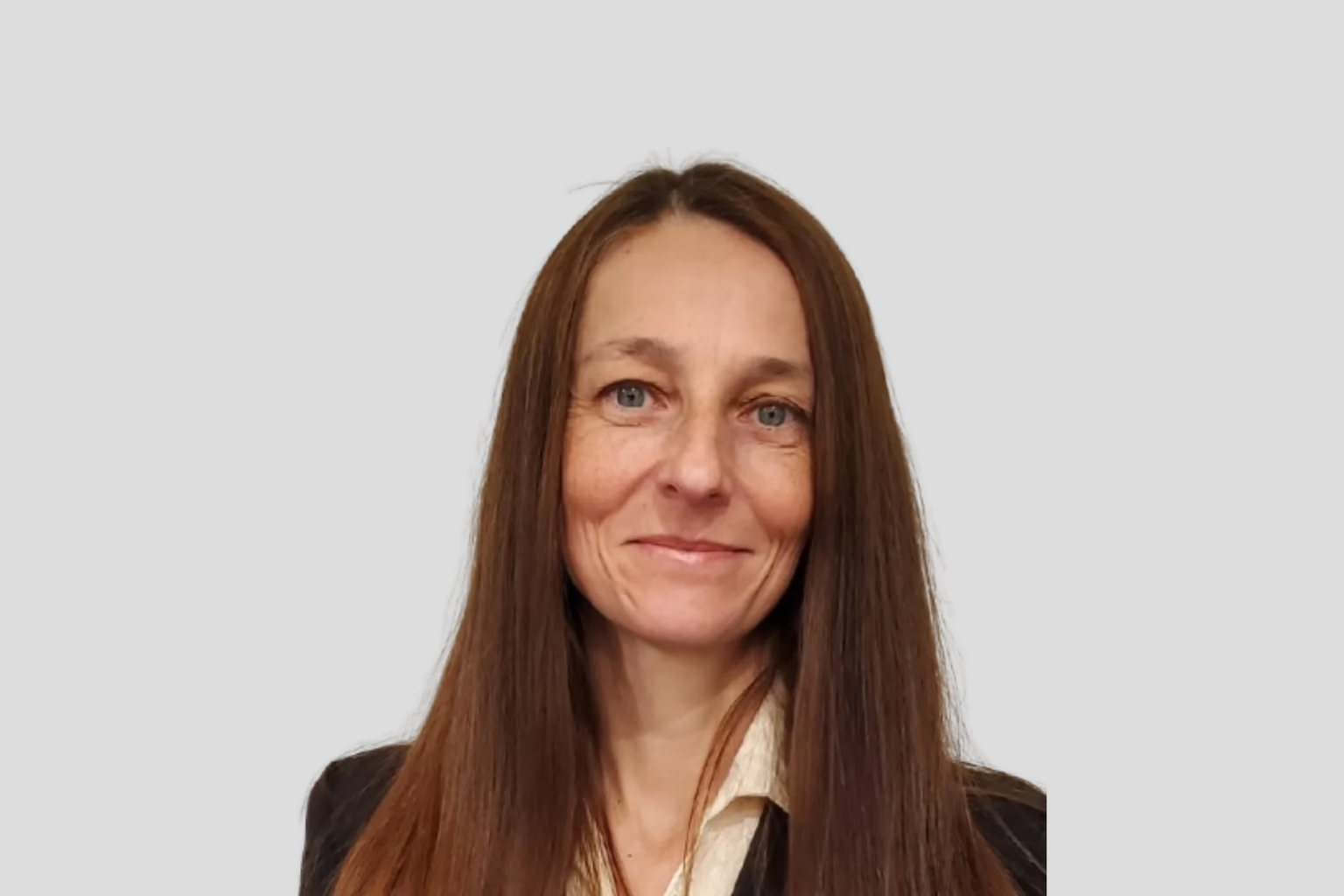
Anna Zwolinska is a seasoned Chartered Business Valuator (CBV) and transfer pricing specialist with extensive experience in international taxation. With a strong foundation in economics, knowledge of transfer pricing and valuation, as well as understanding of complex cross-border financial and business structures, Anna excels in providing insightful solutions to challenging valuation and tax cases.
Currently, Anna works in dispute resolution in the Appeals Branch, CRA, leveraging her expertise to review reassessments and navigate litigation processes. She collaborates closely with legal teams, offering technical guidance on transfer pricing and valuation issues while ensuring compliance with tax law. Her role requires a meticulous approach, balancing detailed research with professional judgment to deliver fair and accurate outcomes.
Anna’s career journey reflects her adaptability and global perspective. Before entering the world of taxation and valuation, she worked amongst other as a translator at the European Commission in Luxembourg, contributing to Poland’s integration into the European Union. Her ability to conduct in-depth research, collaborate across disciplines, and ensure precision has been a hallmark of her professional path.
Passionate about her professional development, Anna holds the CBV designation, demonstrating her commitment to excellence in her field. Her experience and diverse skill set position her as a valuable resource for navigating the complexities of valuation, transfer pricing, and tax law.
Anna also contributes her expertise to the CBV Institute by assisting with the French translation of CBV Matters ensuring clear and accurate communication for a bilingual audience.
How has the CBV Program supported your career development?
The CBV designation has been instrumental in my career development, offering me a unique blend of skills and opportunities. My journey began when I immigrated to Canada in my late 20s with a background in Economics and Business Administration. Initially aiming to work as an economist, I pursued a master’s degree, which led to a role at the CRA in the International Tax Division, focusing on transfer pricing.
I discovered the CBV designation while exploring valuation-related challenges in transfer pricing files. With support from my manager and colleagues, I enrolled in the program to deepen my understanding of valuations.
Though my initial studies were theoretical, a later assignment with the CRA’s valuation team allowed me to apply my knowledge to real cases, enriching my expertise.
The CBV designation has expanded my career horizons within the CRA, enabling me to work on more complex and diverse files, including those combining transfer pricing and valuation issues. It has provided a critical toolset to analyze, research, and form well-supported opinions, contributing significantly to my ability to handle intricate cases. By bridging economics and valuation, I’ve gained a nuanced understanding of how these disciplines address different aspects of a file and collectively inform decision-making.
Overall, the CBV designation has opened doors to new roles, enhanced my professional confidence, and equipped me with the skills to tackle a broad spectrum of challenges, making it a pivotal milestone in my career.
Can you share a particularly challenging yet interesting valuation analysis that made you realize you had chosen the right career path?
Every valuation file I’ve worked on has been uniquely challenging and interesting in its own way, making it difficult to pinpoint just one standout case. For me, each project feels like solving a complex puzzle—an opportunity to answer critical questions while gaining valuable insights. Whether it’s a smaller engagement or a large, high-profile case, every file presents its own set of challenges and learning opportunities.
What I find most rewarding is how each case allows me to explore the nuances of a company, the asset being valued, or the industry it operates in. Depending on the context—be it the economic climate, regulatory environment, or political factors—there’s always something new to uncover. Even when working on a seemingly similar case, factors like the valuation or transaction date can introduce subtle variations that lead to completely different conclusions. It’s this ever-changing dynamic that keeps the work exciting and ensures no two cases are ever the same.
Valuation also involves balancing meticulous research with professional judgement. While assumptions need to be well-supported and the resulting range of values must remain reliable, the process is rarely black and white. There’s a certain fluidity to the conclusions we arrive at, which adds to the intellectual challenge. Sometimes, what appears to be a straightforward file at first glance can reveal unexpected complexities as the analysis progresses, further deepening the learning experience.
For me, the most fulfilling part of valuation is this constant evolution—every file brings the chance to sharpen my expertise and expand my understanding. This dynamic nature of the work reaffirms that I’ve chosen the right career path, as it consistently keeps me engaged, curious, and motivated.
What differences do you see in your current role as compared to your previous role?
In my current role, I’ve noticed significant differences compared to my previous position, even though I’m still working in transfer pricing. Previously, my work focused primarily on the pre-assessment stages of files. As an economist or valuator, I assisted auditors in developing their reassessing positions. This involved issuing opinions that auditors could then rely on in their cases. Essentially, my role centered around building and supporting audit’s positions.
In contrast, my current role is at the post-reassessment stage, where I’m directly involved in dispute resolution. Rather than issuing opinions, my work now involves reviewing the work of both parties in a dispute to assess whether the reassessment issued was accurate. This includes determining whether the reassessment should be vacated, confirmed, or varied. It’s a different type of analytical and evaluative role, requiring a critical and impartial review of previous analyses and outcomes.
Another key difference is my involvement in litigation. In this role, I’m part of every stage of the litigation process, collaborating closely with lawyers. This has provided me with invaluable insights into how litigation works, including legal procedures, tax law interpretation, and the nuances of handling transfer pricing and valuation issues within a legal framework. Additionally, I provide technical assistance to lawyers, which has broadened my understanding of how legal and financial expertise intersect.
Overall, my current role has shifted from providing valuation or economic assistance to audit, to resolving disputes and navigating the litigation process, offering a completely different yet equally rewarding perspective on the field.
Do you have any tips for people looking to become a CBV?
Understand the Role and Industry
Take the time to learn about the work CBVs do, including the challenges and rewards.
Determine if this is truly a career path that excites you, rather than relying solely on others’ recommendations. Not every role suits everyone, and self-reflection is key.
Connect with CBVs
Speak with experienced CBVs to gain insights into the profession and its day-to-day realities.
Talk to individuals who have recently completed the CBV program to understand the challenges and the structure of the coursework.
Gain Practical Experience
If possible, work in valuation while pursuing the program. Applying theoretical knowledge in real-world scenarios helps solidify your understanding and makes the process more engaging.
Practical experience can also make the coursework less overwhelming and more meaningful.
Seek a Mentor
A mentor in the field can provide valuable guidance throughout the program.
They can assist with understanding course material, preparing for exams, and navigating the overall learning journey.
Plan Your Coursework
Assess your schedule and decide how many courses to take per term based on your work and personal commitments.
Avoid overloading yourself with too many courses at once to prevent burnout or discouragement.
Have Fun and Stay Curious
Enjoy the learning process! The program offers an excellent opportunity to gain in-depth knowledge about valuation, industries, and financial analysis.
Stay curious and embrace the journey—it’s a rewarding experience both during the studies and in your professional career.
#FunFact It’s interesting how life takes unexpected turns! If you had asked me during my studies—whether in Poland or even after moving to Canada—if I’d end up working in taxation, I would’ve firmly said, “No way!” At the time, I envisioned myself working on international development projects, perhaps in Africa, Asia, or South America, helping communities tackle various challenges. That was my dream work. Then, I discovered transfer pricing, valuations and taxation, which completely changed the career path I envisioned.